


I hear the ducks before I see them. Their quacks echo across the water, with so many of them it almost turns into a kind of white noise. I peek through the trees of the palm plantation I’m in, picking my way along the edge of the flooded pools to the bank of the lake.
The boat carrying the duck herder is small and narrow, just a little canoe. But he’s steady as a rock, poling his way across the narrow lake and skilfully herding the hundreds of ducks where he wants them to go.

I’ve never seen someone herding ducks before. Cows, sure, sheep and goats, all the time, but ducks? Never. It hasn’t ever occurred to me that that would even be a thing.
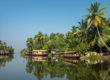
But this is life in the backwaters of Kerala, where everything revolves around water. Where lakes, rivers, and canals dominate the landscape and humans have learned not only to adapt, but to use the waterways for everything from recreation and fun to more practical pursuits such as transportation, gathering food, cooking, and washing clothes.

The Kerala backwaters consist of hundreds of kilometres of canals, lakes, and rivers, in a maze that only a local could possibly understand. Along these waterways are individual homes, villages, towns, and even big cities like Alappuzha. Wooden canoes are tied up outside houses, ready for the farmer to carry his goods to the larger canals, where they can be loaded onto bigger boats to be taken to market.

The waterways are lined with palm trees, which tower over the canals, bordering the larger ones so you can just barely see the green fields beyond. If you stand and watch, before too long a boat will come by – a wooden canoe powered by oars or a motor, a water taxi, or one of the big public ferries, which stop at every little dock along the way.

Life in the backwaters of Kerala follows a rhythm rarely seen in today’s world – one that follows the sunrise and sunset, where life is lived on the water and among the palm trees.

And central to all of this is the people. People here are some of the friendliest, most helpful and kind I have met on my travels. As they go about their daily lives they are quick to say Hello and are often happy to chat while I am rambling around the area.

I stay in a homestay in the backwaters, where George shows me around his spice farm and makes sure I try everything, then answers my endless questions about people, religion, and local festivals. He and his wife feed me all the food I could possibly want, and welcome me into their home, introducing me to their family.
Using George’s hand-drawn maps of the area I wander endlessly in the morning and late afternoon, watching kids jumping in the canals, women washing clothes, people making offerings at little path-side temples, and of course the duck herders!

On one afternoon stroll down the banks of the canals, a couple of young men on a motorbike stop next to me. They’re curious, where am I from? What am I doing here? Do I like Kerala? Of course I do. This area is stunningly beautiful and the people are exceptionally kind.

Children play, their bikes dumped in a pile as they splash each other (and me!), dive in and swim about like fish. If you grow up surrounded by water, you’re going to be a good swimmer.

I get lost on my way back to my homestay, reaching a fork in the road and I am not entirely sure which one will lead me back to George’s house. I stop, contemplating, but a man outside his house sees me. Everyone knows where the foreigners stay. He points out which path to take and I never worry about getting lost again.
Oil lamps flicker in a temple, the Shiva lingam slick with red ochre. The dark interior is a stark contrast to the bright daylight outside. A few hundred metres away there is a church. I am here at Christmas time, and I attend a Christmas eve service where, as I join the huge congregation, I am treated no differently than a local devotee. The very next evening a Hindu procession marches along the far side of the canal, lamps lighting up their faces as they proceed to the temple. People live in harmony here, each accepting and even honouring each other’s religion.

I take a ferry early one morning through the canals. The locals on the nearly-empty boat are amused at me dashing from one side to the other, and they start to point out interesting sights – a shipwrecked fishing boat, a section of lake coated in water lilies, a toddy shop, or a riverside temple. Kids on the ferry grin at me from the safety of their mothers’ arms.

People wait for boats on public docks, the only time I ever see anyone look at a watch here. Tiny shops are located on major corners, selling basics and sweets. People spill out of toddy shops, enjoying the local palm wine.

I have never seen a land where people are so in tune with their surroundings. There is a reason Kerala’s latest tourism campaign is entitled Human by Nature. Life in the backwaters of Kerala is about fresh air, glowing skies at sunrise and sunset, and water, always water, lapping at the docks, the boats, the homes.
Is it this connection with their environment that makes the people so friendly? I know if I need to de-stress or calm down, a nature walk is the best way to do it. Maybe, for these people, having their lives so intertwined with the water and earth is what makes them some of the most chilled out, lovely people I have ever had the pleasure of meeting in my travels.
No matter the reason for the wonderful people, if you want a relaxed holiday in India where you are welcomed with open arms and where nature is woven into daily life, definitely head to Kerala.

This post was sponsored by Kerala Tourism, but all words and opinions are my own!
If you enjoyed this post about life in the backwaters of Kerala, please pin it!

Only today I found the time to thank you for these nice and interesting reports on Greenland and Kerala and also the other destinations we found on your website, Jenny. It brings back so many memories and how life has changed – or not – over the last 40 or 50 years.
Klaus & Deko
Hi Klaus and Deko, I’m so glad you like my blog! I’m glad I could help you with a bit of nostalgia and armchair travel during these stay-at-home times!
Forgot to ask, where and how you are spending this time of travel restrictions due to Covid-19?
Klaus
I am at my home in Oman. I did consider hopping on a plane back to Canada, but the logistics of that were just too difficult and rushed. I’m working from home here, so I might as well stay and get paid. The only real downside is that I’ve had to cancel a couple of vacations, and I don’t know when I might next get the opportunity to go to Canada and see my family!